
The short version
30-second read- Tax is 2% of every sale. It rounds down, caps at 5M per item and only the seller pays; sales under 50 coins and items like bonds are exempt.
- Buy limits reset 4 hours after your first buy. Profit per window is the limit times your margin after tax, so high-limit supplies beat gear for beginners.
- Margin check with one test buy and one test sell. The two fills give the live range; if the spread minus 2% is zero or less, drop the item.
- Compare against processing methods. The wiki lists tanning green dragonhide at about 1.0M and irit unfinished potions at about 1.1M an hour; flipping needs 10M+ to compete.
Overview
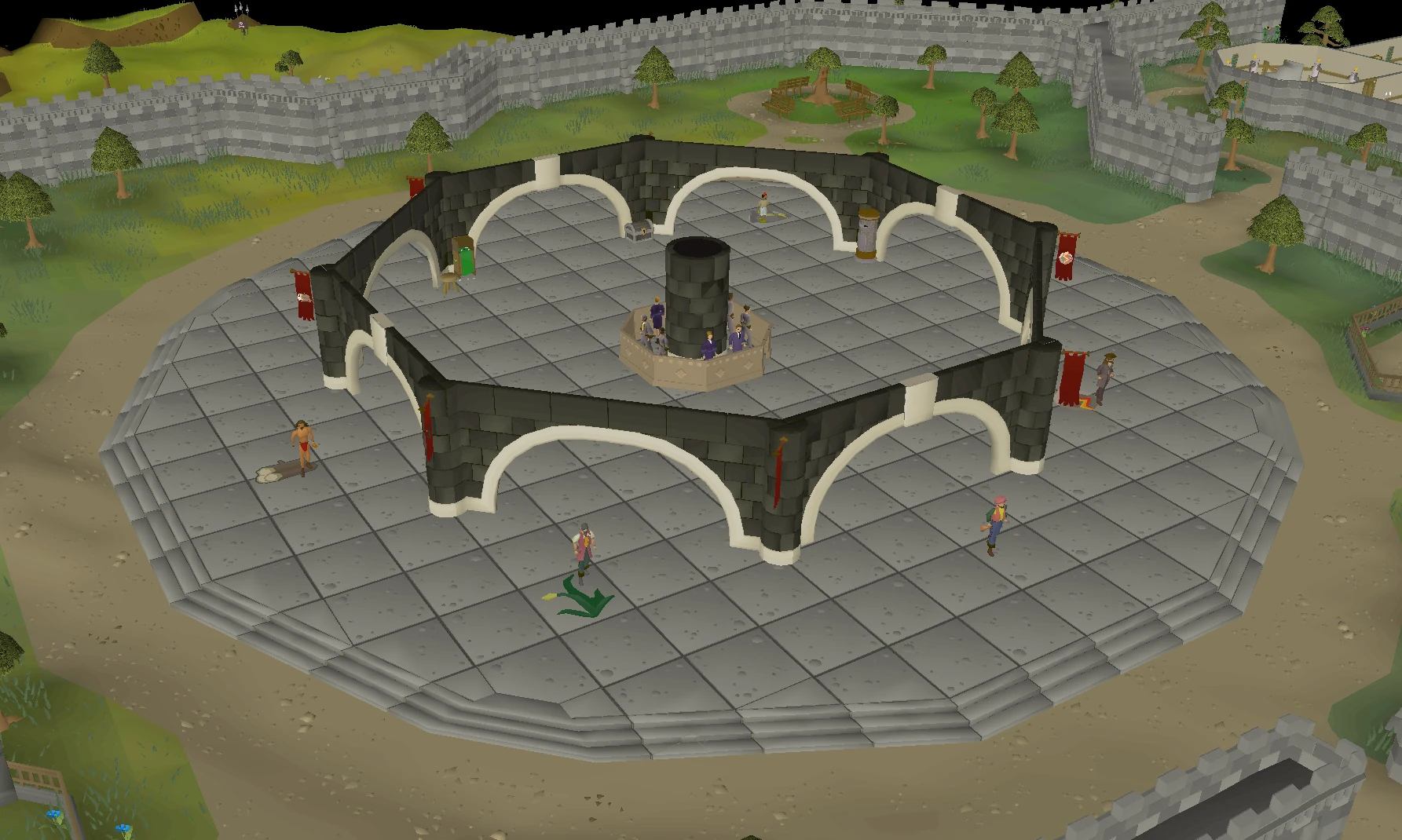
GE flipping is buying an item at the low end of its live price range and selling it at the high end. The Grand Exchange takes 2% of most sales, so the only flips that pay are the ones where the spread beats the tax.
There is no skill requirement and no XP. What you need is spare cash, a written log, and the discipline to stay inside each item's buy limit. The wiki's Merchanting page puts the sensible starting point at 10M; below that, the processing methods in the next section usually pay more per hour.
| Detail | Value |
|---|---|
| Account stage | Any non-ironman account with GE access |
| Offer slots | 8 on members, 3 on free-to-play |
| Starting capital | Wiki guidance: 10M+ for flipping, 20M+ for bulk flipping |
| Tax | 2% of each sale, rounded down, capped at 5M per item |
| Buy limits | Per item, reset 4 hours after the first buy in the window |
| Risk | Medium market risk; no PK risk |
| Attention | Low per minute, high per decision |
| GP/hr on the wiki | Not listed: it depends on your capital and the spreads you find |
Pick your method
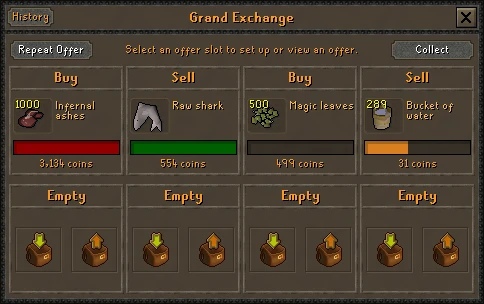
Flipping is one of several ways to make money at the GE rather than from monsters or resources. The others buy an input, change it, and sell the product, or turn gear into coins with High Level Alchemy. All of them run into the 4-hour buy limit, and all but alching pay the 2% tax when they sell.
| Method | GP/hr (wiki) | Requirements | Buy limit vs pace | Risk | Attention | Best for |
|---|---|---|---|---|---|---|
| GE flipping | Not listed | GE access; 10M+ cash suggested | Set by each item's limit per 4 hours | Medium: price can turn while you hold | Low | Main, F2P (3 slots) |
| Making irit potions (unf) | about 1.1M | 45 Herblore, Druidic Ritual, 3M+ cash | Irit leaf 13,000 per 4 h at 4,000 an hour: 3 h 15 min of work per window | Low: thin margin can close | Low | Main |
| Tanning green dragonhide | about 1.0M | No skills; 5M+ cash; 20 coins a hide at Ellis | 13,000 hides per 4 h at 3,500 an hour: about 3 h 40 min per window | Low: thin margin can close | Low | Main, low level |
| Making ranarr potions (unf) | about 970K | 30 Herblore, Druidic Ritual, 32M+ cash | Ranarr weed 11,000 per 4 h at 4,000 an hour: 2 h 45 min per window | Low: thin margin can close | Low | Main |
| Spinning flax to bow strings | about 490K | 10 Crafting; 5K+ cash | Bales of flax 13,000 per 4 h (25 flax each), far above 2,000 an hour | Low | Low | Low level |
| High alching profitable F2P items | about 490K | 55 Magic; staff of fire; 20M cash recommended | Rune 2h sword 70 and adamant platebody 125 per 4 h, so it takes several items to fill 1,200 casts an hour | Very low: alch value is fixed | Low | F2P, main |
GP/hr figures are the wiki's at 14 October 2026 and move with Grand Exchange prices.
The "Buy limit vs pace" column is there because the wiki's Money making guide says its hourly figures ignore buy limits and the time spent buying. A long session on ranarr potions runs out of herbs before the 4-hour window resets, so the real rate over a day is lower than the table shows.
Unfinished potions and herb prices are covered in the Herblore guide, leather in the Crafting guide, and which items to alch where in the alching guide. Ironmen cannot use any row of this table; see the ironman section below.
Flipping vs merching vs high alching
The wiki treats merchanting (merching) as the umbrella term. In practice players say flipping for quick spread trades and merching for slower bets on where a price is heading, which the wiki calls investing. High alching is the third option because it puts a hard floor under alchable gear.
| Flipping | Merching (investing) | High alching | |
|---|---|---|---|
| Profit comes from | Spread between instant buy and instant sell | Price trend over days or longer | Fixed alch value (60% of item value) minus item and nature rune |
| Hold time | Minutes to a few hours | Days or longer | 3 seconds per cast, 1,200 casts an hour |
| Capital the wiki suggests | 10M+ (20M+ for bulk) | Not stated | 20M (F2P alching guide); 55 Magic |
| GE tax paid | 2% on every sale | 2% on the sale | None: you never sell, and buying is untaxed |
| GP/hr on the wiki | Not listed | Not listed | about 490K (F2P items) |
| Worst case | Stuck in a falling item | Stuck for days in a falling item | A small loss per cast if you overpay |
| XP | None | None | 65 Magic XP per cast, 78,000 an hour |
Verdict: pick flipping if you have 10M+ and can check offers a few times a day, merching only with money you can leave alone for days, and high alching if you want a fixed payout per item plus Magic XP.
Why alch value works as a price floor
High Level Alchemy pays 60% of an item's store value, no matter what the GE says. An adamant platebody always alchs for 9,984 coins and a rune 2h sword for 38,400. If either trades below its alch value minus a nature rune, alchers buy every copy they can, which is why prices of alchable gear tend to sit at or above that line.
Use it when you flip gear. If you buy near the alch line and the flip fails, you alch the stack and lose a few coins per item instead of dumping it into a falling market. The catch is volume: the buy limit is 125 on adamant platebodies and 70 on rune 2h swords per 4 hours.
Requirements
No quest or skill unlocks flipping. The limits are account type, account age and cash.
| Requirement | Detail |
|---|---|
| Not an ironman | Ironmen can only buy bonds on the GE, and cannot sell them. |
| Trade-unrestricted account | New F2P accounts cannot sell some items (logs, fish, ores, runes, feathers and more) until they have 20 hours played, 10 quest points and 100 total level (Account). |
| Spare capital | 10M+ is the wiki's guidance for flipping, 20M+ for bulk flipping low-margin items. Gear money is not flip money. |
| Free slots | 8 on members, 3 on F2P. F2P players can only buy F2P items, but anyone can list members' items for sale since June 2023. |
| Requirement | Detail |
|---|---|
| A tracking sheet | Item, quantity, buy price, sell price, tax, and the time of your first buy (for the 4-hour timer). |
| An approved client | Only the official clients, RuneLite and HDOS are allowed (Code of Conduct). Anything that places offers for you is macroing. |
| 55 Magic | Lets you alch a failed gear flip instead of selling it at a loss. |
Setup
Setup is splitting your cash and choosing a short watchlist, not filling every slot on day one.
- 1
Move flip cash into its own pile, separate from your gear budget.
- 2
Pick 4–6 liquid items in your price range.
The wiki's own example: with 100,000 coins, choose items around 250–500 coins so you can buy 200–400 of each.
- 3
Write down each item's buy limit and whether it shares a connected limit (all doses of prayer potion count against one limit).
- 4
Margin check each item (next section) and log the instant-buy and instant-sell prices.
- 5
Write a maximum loss per item before the first buy goes in.
- 6
Plan slots: on members, 8 slots cover 4 items with a buy and a sell each.
On F2P, 3 slots means one item at a time with a spare.
Margin checking, step by step
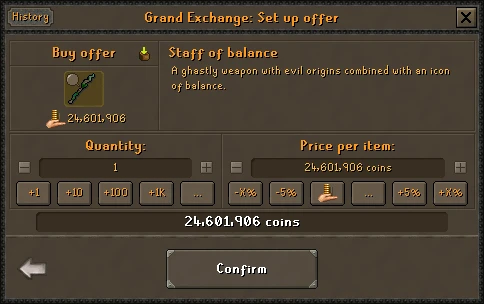
A margin check finds the live range by crossing the market once in each direction. A buy offer above the lowest sell offer fills at that sell offer's price and refunds the rest; a sell offer below the highest buy offer fills at that buy offer's price and pays you the extra.
- 1
Buy one of the item well above the guide price.
Where it fills is the instant-buy price, the most you can sell for right now.
- 2
Sell that same item well below the guide price.
Where it fills is the instant-sell price, the least you can buy for right now.
- 3
Margin = instant-buy minus instant-sell.
Tax = 2% of your sell price, rounded down.
- 4
If margin minus tax is zero or negative, drop the item and check the next one.
- 5
Otherwise place your real buy at or just above the instant-sell price and your sell at or just below the instant-buy price, then wait.
- 6
Re-check after a few hours.
Ranges move, and a margin from this morning is not a margin tonight.
Worked example
| Step | Quantity | Coins |
|---|---|---|
| Test buy above guide | 1 | Fills at 1,000 |
| Test sell below guide | 1 | Fills at 960; tax 19; you get 941 |
| Cost of the test | 1 | 59 |
| Real buy offer at 960 | 13,000 (buy limit) | 12,480,000 tied up |
| Real sell offer at 1,000 | 13,000 | Tax 20 each; you get 980 each |
| Profit if every unit fills | 13,000 | 13,000 × 20 = 260,000 |
The prices are made up to show the arithmetic; the quantity is real. 13,000 is the 4-hour buy limit on green dragonhide, irit leaf and bales of flax. Note how the 40-coin spread shrinks to 20 after tax. On a 1,000-coin item, any spread under 20 coins loses money.
GE tax: the 2% rule and what is exempt
Most sales pay a 2% convenience fee, rounded down to a whole coin and capped at 5,000,000 coins per item. Only the seller pays it; buying is untaxed. The cap starts to bite at a sale price of 250M per item.
| Sale price per item | Tax | Seller receives |
|---|---|---|
| 49 | 0 | 49 |
| 50 | 1 | 49 |
| 1,000 | 20 | 980 |
| 10,000 | 200 | 9,800 |
| 1,000,000 | 20,000 | 980,000 |
| 250,000,000 | 5,000,000 (cap) | 245,000,000 |
| 500,000,000 | 5,000,000 (cap) | 495,000,000 |
Rounding down has one useful side effect. A sell offer at 1,000 and one at 999 both pay the seller 980, so undercutting an offer that sits on an exact multiple of 50 costs you nothing.
| Group | Exempt items |
|---|---|
| Bonds and potions | Old school bonds, energy potions |
| Low-level ammo and runes | Bronze, iron and steel arrows; bronze, iron and steel darts; mind runes |
| Low-level food | Bass, bread, cake, cooked chicken, cooked meat, herring, lobster, mackerel, meat pie, pike, salmon, shrimps, tuna |
| Teleports | Ardougne, Camelot, Civitas illa fortis, Falador, Kourend castle, Lumbridge, Teleport to house and Varrock tablets; games necklace(8); ring of dueling(8) |
| Tools | Chisel, gardening trowel, glassblowing pipe, hammer, needle, pestle and mortar, rake, saw, secateurs, seed dibber, shears, spade, watering can |
On exempt items the spread you see is the spread you keep, so even a 1-coin margin is profit. Everything else carries the other costs a ledger has to show:
- Capital locked in items that fill slowly
- Losses when you cut a bad position
- Margin-check costs (59 coins in the worked example, far more on expensive items)
- Time you could have spent on a method from the table above
Buy limits and the 4-hour timer
Each item can only be bought in a set quantity every 4 hours. The timer starts with the first item you buy and resets fully 4 hours later, however your later buys were spread out. Some items share a connected limit, and selling has no limit at all (Grand Exchange/Buying limits).
| Item | Limit per 4 hours | Members | Most per day (6 windows) |
|---|---|---|---|
| Rune 2h sword | 70 | No | 420 |
| Old school bond | 100 | No | 600 |
| Adamant platebody | 125 | No | 750 |
| Prayer potion(4) | 2,000 | Yes | 12,000 |
| Shark | 10,000 | Yes | 60,000 |
| Ranarr weed | 11,000 | Yes | 66,000 |
| Green dragonhide | 13,000 | Yes | 78,000 |
| Nature rune | 18,000 | No | 108,000 |
| Death rune | 25,000 | No | 150,000 |
Profit per window is the buy limit times your margin after tax. A 20-coin net margin on a 70-limit item makes 1,400 coins a window; the same margin on a 13,000-limit item makes 260,000. That gap is why beginners do better on high-limit supplies than on gear.
How to Calculate Realistic Profit
Only closed trades count: bought and sold, or bought and cut. Offers still sitting in a slot are not profit yet.
- 1
Per item: sell price minus tax minus buy price.
- 2
Per window:
that figure times the units that actually filled, not the buy limit.
- 3
Per week: the sum of your windows minus every loss from cut positions and margin checks.
- 4
Per hour: weekly profit divided by the hours you spent checking margins and managing offers, not the hours you were logged in.
- 5
Return on capital: weekly profit divided by the cash tied up.
In the worked example, 260,000 on 12,480,000 is about 2.1% for one window.
Then hold your hourly number against the table at the top. If tanning green dragonhide at about 1.0M an hour beats your flipping rate for the same attention, tan hides and flip on the side.
Ironman Relevance
Ironmen cannot flip. The GE gives them a separate interface that buys bonds and nothing else, and they cannot sell bonds. Iron money comes from drops, shops and skilling: see ironman money making.
Common Mistakes
Most beginner losses come from five habits:
- 1
Treating the guide price as the margin.
The guide price is built from recent trades and updates every 3 hours. Only a buy and a sell that actually fill show the live range.
- 2
Forgetting the 2% on the sell side.
A 40-coin spread on a 1,000-coin item is 20 after tax; a 15-coin spread is a loss.
- 3
Scaling before testing.
The wiki's rule is buy 10 and sell 10, then 50, then 250. Buying the full limit of an untested item is how starter cash gets stuck.
- 4
One item, all the capital.
The wiki suggests four to six items so one crash does not take the whole stack.
- 5
Misreading the buy limit.
The timer runs from the first buy, and connected items like prayer potion doses share one limit, so the "second half" of your buy never fills.
When to Move On
Switch or scale when one of these is true:
- Your profit per active hour is below a processing method you could do instead, such as tanning green dragonhide at about 1.0M on the wiki today.
- Your spreads keep coming back under 2% of the price, which is a loss after tax: the item is crowded, so replace it on your watchlist.
- Your flip pile passes 20M, the wiki's threshold for bulk flipping (large quantities at a margin of a few coins each).
FAQ
How much GP do I need to start flipping?
The wiki's Merchanting page recommends at least 10M, and 20M or more for bulk flipping. You can learn the process with less by flipping small quantities, but the profit will be small and the processing methods in the table above will out-earn it.
What items should beginners flip?
Items with high trade volume and a price that moves: runes, arrows, darts, logs, ores, bars, food, potions, herbs and seeds are on the wiki's list. Check the price graph first, and skip items whose price barely changes.
How does the GE tax work?
The seller pays 2% of the sale price, rounded down, capped at 5M per item. Sales under 50 coins pay nothing, buying is never taxed, and bonds, energy potions and a list of low-level items are exempt.
How long does the GE buy limit take to reset?
4 hours from the first item you bought in that window. Buying more later in the window does not push the reset back.
Is flipping faster than skilling?
Only with enough capital. The wiki lists no GP/hr for flipping because it depends on your stack and the spreads you find. Work out your own rate per active hour and compare it with methods like tanning hides at about 1.0M.
Is flipping against the rules?
No. Buying and selling by hand on the GE is the GE working as designed. Bots or software that place offers for you count as macroing, and trading GP for real money is real-world trading; both are against the Code of Conduct.
Can you flip on a free-to-play account?
Yes, with 3 slots instead of 8, and you can only buy F2P items. A new F2P account also cannot sell some common items until it reaches 20 hours played, 10 quest points and 100 total level.
Still stuck on a mechanic? Ask the team on our Discord, it is free.
Where paid help fits
Flipping grows a stack slowly and needs a stack to start. If one specific upgrade is the goal and your capital is too small to flip toward it, the OSRS gold page is the other route. Buying GP is real-world trading under the Jagex rules, so read what to know before you buy gold first.
Bottom Line
Margin check, subtract 2%, respect the 4-hour limit, and log every closed trade. Start with 4–6 liquid, high-limit items and scale from 10 to 50 to 250 as the wiki suggests.
If your rate per active hour falls below tanning hides or making unfinished potions, do those instead and keep flipping as a side income.
Sources
Numbers and mechanics on this page come from these 12 OSRS Wiki pages:
- Grand Exchange
- Merchanting
- Money making guide/Making irit potions
- Money making guide/Tanning green dragonhide
- Money making guide/Making ranarr potions
- Money making guide/Spinning flax to bow strings
- Money making guide/High alching profitable free-to-play items
- Money making guide
- High Level Alchemy
- Account
- Code of Conduct
- Grand Exchange/Buying limits
Enjoyed the guide?
Drop a like — it helps other Adventurers find the good stuff.
Community
Comments
Silence in the hall…
Be the first Adventurer to leave a mark.
Join the thread
Add a comment
Tips, drops, or “this carried my account” — keep it useful.